
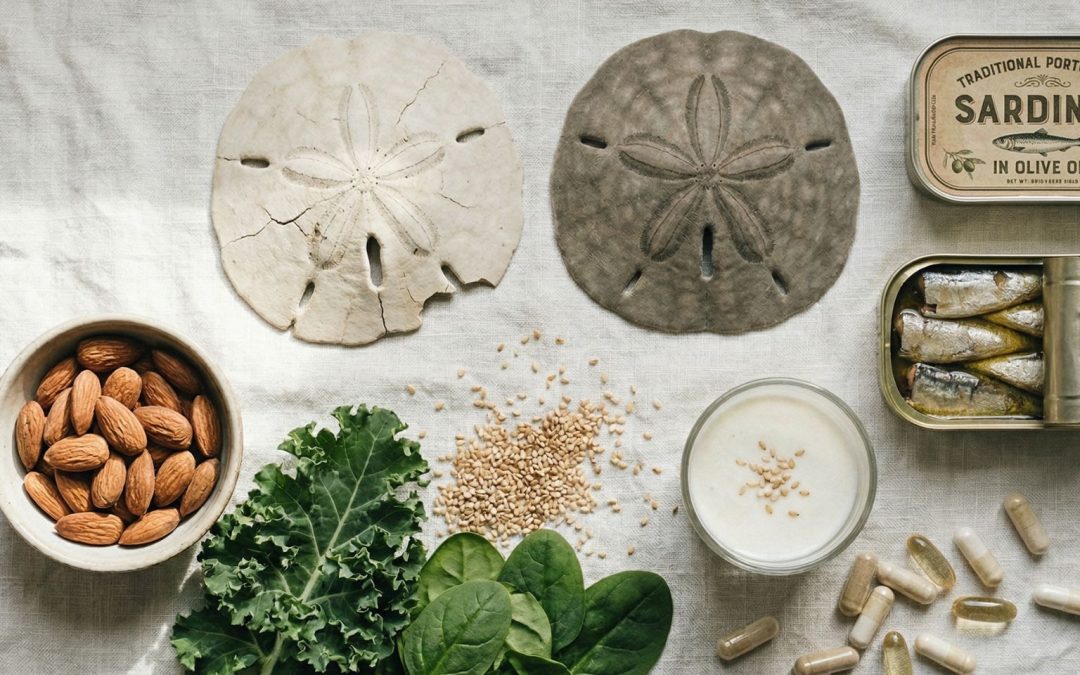
The Sand Dollar Secret: What the Ocean Reveals About Your Bones
Inside every bleached, brittle sand dollar is a clue your skeleton has been trying to tell you
That moment? It’s one of the best biology lessons you’ll ever hold.
Because here’s what most people don’t know: your bones are doing exactly the same thing. Not because bones are fragile by nature — but because bone is living tissue, and when the living part starts to fade, what’s left behind is just mineral. And mineral alone snaps.
This isn’t a scare story. This is the Health Detective taking a close look at what’s actually happening inside your skeleton, what steals the life from bone before you ever feel a thing, and what you can do right now — to keep your bones behaving like they’re alive. Because they should be.
The Sand Dollar Was Never Just a Shell
A living sand dollar is covered in thousands of tiny, hair-like spines and cilia that move constantly, helping it burrow, breathe, and feed. It’s dark purple or brown. It flexes. It’s full of organic tissue — proteins, fluids, living cells. The hard disc underneath (called the test) is its internal skeleton, but it’s wrapped in and interwoven with living material that keeps it resilient.
When a sand dollar dies, all that living tissue disappears. What’s left is pure calcium carbonate — the mineral framework, stripped of everything that gave it flex and strength. And that’s when it becomes brittle.
Your bones work on the exact same principle. Bone is roughly 30% organic matrix — primarily Type I collagen — and 70% mineral, mainly calcium hydroxyapatite. The collagen is the scaffold. The mineral fills that scaffold. One without the other doesn’t work. Collagen alone would be rubbery and weak. Mineral alone would be chalk. Together, they create something that can absorb impact, flex slightly under load, and resist fracture.
When bone starts to lose either component — the organic framework or the mineral — what you get is the biological equivalent of a dried-out sand dollar.
What’s Really Happening Inside Living Bone
This is where the detective work gets fascinating, because bone isn’t passive. It’s not just sitting there holding you upright. It’s constantly being broken down and rebuilt in a process called remodelling, and it never stops for your entire life.
Two types of cells run this operation:
Osteoclasts are the demolition crew. They dissolve old or damaged bone, releasing minerals back into the bloodstream.
Osteoblasts are the construction team. They lay down new collagen matrix and then mineralise it, building fresh, strong bone.
In ideal conditions, these two teams stay in balance. Old bone comes down, new bone goes up, and your skeleton stays dense and resilient. In a healthy young adult, about 10% of the entire skeleton is remodelled every single year.
The problem — and this is where it gets personal — is that this balance is exquisitely sensitive to hormones, nutrients, and lifestyle signals. And several things that are completely normal in the second half of life can tip that balance toward breakdown faster than rebuilding can keep up.
The Hormonal Shift That Changes Everything
Research shows that in the first five to seven years after menopause, women can lose between 1% and 3% of bone density per year. That’s not a slow drift. Over a decade, that’s potentially 20% of your bone mass — and it often happens quietly, with no symptoms at all.
What makes this particularly tricky is that the first sign for many people isn’t a bone scan. It’s a fracture.
But here’s what the investigative lens reveals: oestrogen isn’t the only player. Cortisol (the chronic stress hormone) actively suppresses osteoblast activity and accelerates bone loss. Thyroid hormones in excess do the same. Gut health determines how well you absorb the nutrients bone depends on. Stomach acid — which declines with age — is essential for absorbing calcium from food. Even your breathing pattern affects bone pH.
Bone health is a systems story. And that means there are many more entry points to support it than most people realise.
The Nutrients That Keep Bone Alive — and What Most People Get Wrong
Yes, calcium matters. But the form and context matter enormously. Calcium carbonate (the most common supplement form) requires adequate stomach acid to be absorbed, and stomach acid production often declines with age. Calcium citrate or calcium malate are absorbed more reliably without needing high stomach acid — making them the better choice for many adults over 40.
And here’s what often gets missed: calcium supplements taken without the co-factors that direct calcium into bone can actually deposit calcium in soft tissues and arteries instead. Which brings us to the two nutrients that change everything.
Vitamin D3 — The Calcium Doorman
Without sufficient Vitamin D3, calcium from food and supplements simply doesn’t get absorbed through the gut wall. Your body might have excellent calcium intake on paper and still be building nothing with it. D3 also plays a direct role in osteoblast activity, and most adults — especially those in northern climates or who spend limited time outdoors — are running well below optimal levels.
The key is getting levels actually tested (serum 25-OH Vitamin D) rather than guessing. Optimal bone support tends to require levels in the 100–150 nmol/L range, which often requires supplementation well above the standard recommended dietary amount.
Vitamin K2 as MK-7 — The Traffic Director
This is the nutrient that genuinely changes the calcium conversation, and it’s still wildly underappreciated. Vitamin K2 activates two critical proteins: osteocalcin, which anchors calcium into bone matrix, and Matrix GLA Protein (MGP), which actively removes calcium from arteries and soft tissue.
In plain terms: K2 tells calcium where to go and where not to go. Without it, calcium supplementation can build up in the wrong places.
The MK-7 form (derived from fermented foods like natto) has a much longer half-life in the body than MK-4, meaning it stays active far longer with a single daily dose. Look for at least 100–200 mcg daily.
Magnesium Glycinate — The Quiet Backbone
Magnesium is involved in over 300 enzymatic reactions, and its role in bone health is threefold: it’s a structural component of the bone mineral itself, it’s required to activate Vitamin D3 (meaning all the D3 in the world won’t work without sufficient magnesium), and it regulates parathyroid hormone, which controls calcium metabolism.
Most adults don’t get enough from food, and standard magnesium oxide supplements are poorly absorbed and often cause digestive upset. Magnesium glycinate is the gentler, far better-absorbed form — and a bonus is that it also supports sleep quality and stress recovery, both of which matter for bone.
Collagen — The Framework Nobody Talks About
Remember that sand dollar analogy — mineral without the organic framework is chalk. Bone is 30% collagen by weight, and that collagen scaffold is what gives bone its capacity to flex under pressure without shattering. As collagen production slows with age, bone loses that quality even if mineral density looks adequate on a scan.
Type I and Type III collagen peptides (hydrolysed for absorption) provide the amino acids osteoblasts use to build new matrix. Glycine and proline are particularly important here. Daily supplementation of 5–10g of hydrolysed collagen, combined with Vitamin C (which is essential for collagen cross-linking), supports the organic side of bone that DEXA scans don’t measure.
Silica — The Underrated Builder
Silica (silicon) plays a direct role in collagen synthesis and bone mineralisation. Studies show that higher silica intake correlates with greater bone mineral density, and it appears to work by activating osteoblasts and improving collagen quality. Food sources include oats, millet, cucumbers, and horsetail herb — or it can be supplemented as orthosilicic acid, the most bioavailable form.
Boron — The Bone Mineral Keeper
Boron is one of those trace minerals that barely gets mentioned but consistently shows up in bone research. It reduces urinary calcium and magnesium excretion (meaning you lose less of what you’re working hard to absorb), and it supports oestrogen metabolism in a way that may help maintain bone-protective hormonal signals. Food sources include prunes, raisins, almonds, and avocados. Supplemental doses of 3–6 mg daily have been studied in bone research.
Protein — Often the Most Overlooked Piece
Bone is a protein structure. Without adequate dietary protein — particularly leucine, glycine, and proline — osteoblasts don’t have the raw materials to lay down new matrix. Research consistently shows that inadequate protein intake accelerates bone loss in older adults. The old fear that protein makes bones more acidic and leaches calcium has been largely debunked; in reality, protein supports both bone formation and calcium retention.
The Lifestyle Signals That Speak Directly to Bone
Load-Bearing Movement is Non-Negotiable
Bone responds to mechanical stress. When you walk, run, dance, lift weights, or do any movement that loads the skeleton against gravity, osteoblasts receive a direct signal to build. This is called Wolff’s Law — bone adapts to the demands placed on it.
Swimming and cycling, while wonderful for cardiovascular health, are not bone-building activities because they don’t load the skeleton. Weight-bearing exercise — including resistance training — is one of the most evidence-backed interventions for maintaining bone density at any age.
Even 20–30 minutes of weight-bearing movement three to four times per week makes a measurable difference. This is one of the most direct conversations you can have with your skeleton.
Stress, Sleep, and the Cortisol Connection
Chronic elevated cortisol is genuinely bone-eroding. It suppresses osteoblast function, accelerates bone resorption, and interferes with calcium absorption in the gut. This means that chronic stress isn’t just an emotional experience — it’s a skeletal one.
Sleep is when the majority of bone rebuilding occurs. Growth hormone, which peaks during deep sleep, directly stimulates osteoblast activity. Consistently poor sleep isn’t just exhausting; it’s a structural problem for bone tissue.
Red Flags: When to Investigate Further
Some signs that the bone remodelling balance may be tipping in the wrong direction:
- Gradual height loss (even a centimetre or two over a few years suggests vertebral compression)
- Back pain, particularly in the mid or lower spine without an obvious injury cause
- A fracture from a fall that most people would have walked away from
- Family history of osteoporosis or hip fracture
- Early menopause (before 45), whether natural or surgical
- Long-term use of corticosteroids, proton pump inhibitors (PPIs), or anticonvulsants — all of which affect bone metabolism
- A history of an eating disorder, very low BMI, or extended periods of very low calorie intake
- Celiac disease or other gut conditions that impair nutrient absorption
If any of these apply to you — or someone you care about — a conversation with a healthcare provider about a DEXA bone density scan is worth having. It’s a simple, low-radiation scan and it gives you actual data rather than guesswork.
The Investigative Summary: Building Bone That Bends
Your bones tell the same story. Density matters, but so does quality. Calcium matters, but only when it’s directed properly by K2 and activated by D3 and magnesium. The mineral matters, but so does the collagen scaffold that holds it. And the whole system matters — the hormones, the stress response, the sleep, the movement, the protein on your plate.
The brittle sand dollar on the beach isn’t the goal. The living one, moving through the water, is.
Closing the Case
The good news is that bone is living tissue. It responds. It adapts. It rebuilds when you give it the right signals. Whether you’re looking at this for yourself, or you’re thinking about a parent or someone you care about who seems to be shrinking a little or is more cautious than they used to be — this is the right time to start looking more closely.
Pick up a sand dollar next time you find one. Feel how light it is, how easily it cracks. Then put it down and go lift something heavy.

More to Explore

Decoding Menopause: What Each Phase Is Actually Doing to You
Decode what’s really happening in each phase of menopause — and uncover the nutrition that actually supports your body through every stage, not just symptoms.

The Passport Myth: Does Any Culture Really Run Hotter?
Uncover the real truth behind the “hot-blooded” stereotype — decode what actually drives desire and libido, and why culture keeps getting mistaken for biology.

The Truth About Desire: What’s Really Going On With Your Libido
Uncover the real story behind changing libido and desire at midlife — decode what’s actually happening in your body, and why it deserves more than silence.