
Opening the Case
But hands-free doesn’t mean weight-free. It just means the weight moved somewhere your body was never built to carry it for an hour at a time — a shoulder, a neck, an ear canal that was never quite the right shape for what you put in it.
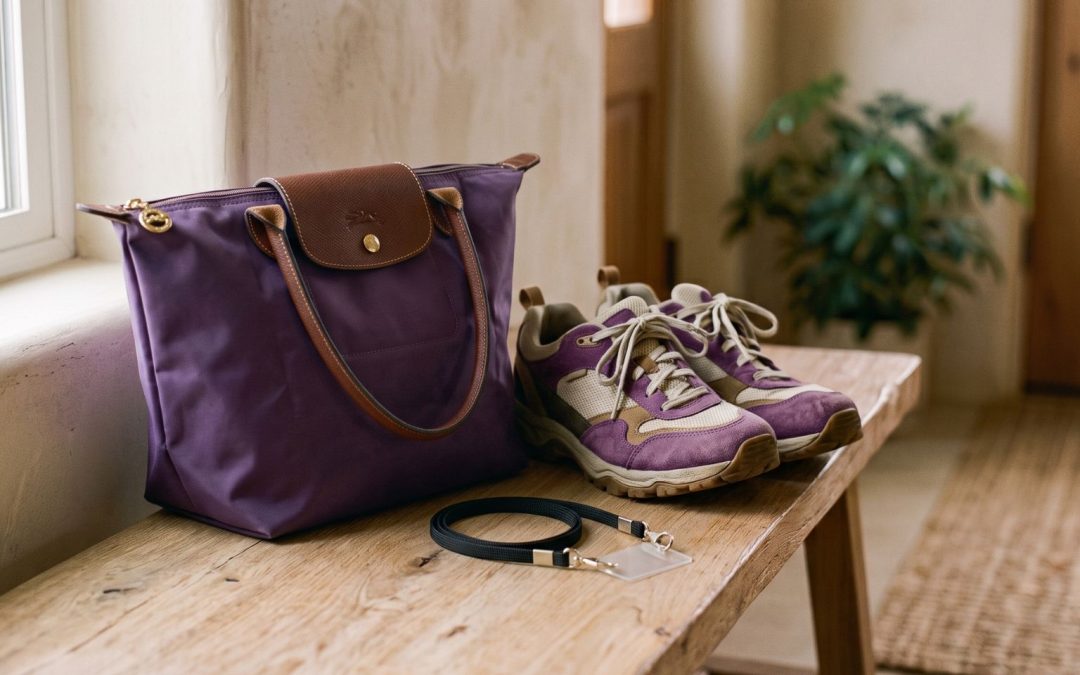
This case looks at four ordinary things most of us wear without thinking twice: the bag, the cord or earbuds, the backpack, and the jewellery around your neck. None of them look like a problem. That’s exactly why they’re worth investigating.
Clue #1 — The Bag on One Shoulder
Carrying a bag on one shoulder isn’t neutral. Your body compensates for the extra weight on one side by hiking that shoulder up and shifting your spine away from the load — small adjustments, repeated for as long as the bag stays on.
One controlled study found that a bag worn on a single shoulder noticeably increased upper-back rounding while people walked. And before you switch to wearing it diagonally across your body thinking that solves it — the same study found that position increased curvature at both the upper back and the lower back at once. Diagonal isn’t automatically better. It’s just a different kind of compensation.
The general guidance across orthopedic sources: keep a bag under roughly 10% of your body weight, and switch shoulders every 20 to 30 minutes if you’re out for a while. Same principle as sitting too long — your body wasn’t built to hold any one position, loaded or not, indefinitely.
Clue #2 — The Backpack, Worn Wrong
A backpack sounds like the responsible choice — weight distributed across both shoulders instead of dragging on one. And it can be, if it’s actually worn the way it’s meant to be.
The rule of thumb across spine health sources: keep a backpack under about 10 to 15% of your body weight, with the straps snug enough that the pack sits close to your back rather than sagging away from it. When a pack is too heavy, or hangs too low, your body leans forward to compensate, and your shoulders and neck end up doing work they weren’t built to sustain all day.
Interesting side note: research comparing crossbody-style carrying to single-shoulder carrying found less shoulder drop and less side-to-side lean with the crossbody style for the same weight. A small design choice, a measurable postural difference.
This is the guardrail worth repeating from every article in this series: none of this means pain caused by disconnection or a lack of meaning is less real, or that finding purpose will make a genuine structural problem disappear. If pain is new, worsening, or comes with swelling, warmth, fever, or neurological symptoms, that needs a proper medical workup — connection and meaning support coping, they don’t replace diagnosis. What the research does show is that isolation and disconnection make an already-difficult situation measurably harder on the nervous system. That’s worth treating as a real, addressable clue, not a soft add-on.
Clue #3 — Spiritual Distress Predicts Worse Pain Outcomes
Phone lanyards are having a moment — hands-free, always visible, no more patting your pockets. Nobody’s studied the lanyard itself yet. But the biomechanics underneath it are well documented, and they have a name: text neck.
Spine surgeon Kenneth Hansraj’s widely cited research found that your head, held in a neutral position, loads your cervical spine at around 10 to 12 pounds — about what it actually weighs. Tilt it forward just 15 degrees, the angle most of us use to glance down at a phone on a cord, and that load jumps to roughly 27 pounds. At 60 degrees, the angle of full-on scrolling, it can reach 60 pounds. That’s not a typo. That’s the weight of an eight-year-old, hanging off your neck, for however many minutes you spend looking down.
A lanyard doesn’t cause that tilt on its own. But it makes checking your phone so easy and so constant that the tilt happens far more often than it would otherwise — and frequency is exactly what turns a harmless glance into a cumulative load.
Nervous system educator Irene Lyon often points out that the body keeps physiological score of small repeated strains long before any single one of them registers as an injury — which is exactly how postural habits like this tend to sneak past notice.
— paraphrased from the work of Irene Lyon, nervous system educator
Clue #4 — When Your Earbuds Have Never Actually Fit
Here’s one most people never think to question: does your earbud actually fit your ear, or have you just gotten used to it not quite fitting?
Ear canals vary enormously from person to person — not just in length, but in width, curve, and depth. Research measuring adult ear canals found diameters ranging from under 4 millimetres to over 13 millimetres depending on the region measured. That’s a huge spread for a product sold in three generic sizes.
When an earbud doesn’t seal properly, most people assume it’s their technique — reinsert, twist, press harder. Often it’s simply the wrong shape for that ear. A poor seal means constant micro-adjusting, pressure points, and — over hours of wear — genuine discomfort in the jaw and around the ear that gets blamed on everything except the actual cause.
This is worth saying personally, not just clinically: it took me until my sixties to learn my own ear canals are small, after decades of corded earphones, then standard wireless ones, none of which ever quite sat right. What finally worked was switching to a clip-on style that rests on the outer ear instead of wedging into the canal at all. If you’ve spent years assuming earbuds are simply uncomfortable, it might be worth asking whether it was ever the earbud’s fault to begin with — not yours.
Clue #5 — The Necklace You Forget You’re Wearing
Here’s one that doesn’t get talked about nearly as much as bags or backpacks: what’s hanging around your neck all day.
A backpack, done properly, distributes weight across both shoulders and sits against your back — your body has some support behind it. A statement necklace doesn’t work that way. A heavy pendant pulls forward, off the front of your collarbone, with nothing on the other side to balance it. It’s a small, constant, one-directional tug on the same muscles that are already working overtime from forward head posture.
A London-based orthopedic surgeon who treats a steady stream of these injuries has linked heavy statement necklaces to poor posture, neck and spine pain, and shoulder impingement — the tightening and shortening of upper chest muscles that comes from repeatedly pulling the shoulders and chest forward. It’s not a large body of research the way backpacks or text neck are. But the mechanism is the same one showing up everywhere else in this article: small, repeated, forward-pulling load, worn for hours, on a body that was never braced for it.
This isn’t a case against jewellery. It’s a case for noticing weight the same way you’d notice it in a bag or a backpack. If a necklace leaves a mark, a groove, or a dull ache by the end of the day, that’s not vanity — that’s your body giving you a straightforward reading. A shorter length, a hollow chain, or simply saving the heaviest pieces for a few hours rather than a full day covers most of it.
Nutritional Support
None of this is solved by supplements. But a body that’s carrying repeated postural strain benefits from the same nutrients that support any overworked muscle and joint.
— Magnesium glycinate — or pumpkin seeds and leafy greens on the plate — supports muscle relaxation in chronically tight shoulders, neck, and jaw; the glycinate form is gentle and well absorbed if you supplement.
— Omega-3s (EPA/DHA) — sardines, salmon, walnuts, or a quality fish oil — help modulate the low-grade inflammation that comes with sustained muscular strain.
— Collagen with vitamin C — bone broth alongside citrus or bell peppers covers both; your body needs the vitamin C to actually use collagen for connective tissue repair, which matters when shoulders and neck are under repeated load.
— Adequate protein through the day — muscles doing constant postural compensation need the raw material to recover, not just at dinner but spread across meals.
— Water, plainly — synovial fluid, the substance that lubricates every joint under load, is roughly 70-80% water, and cartilage holds a similarly high water content. Even mild dehydration thins that fluid and stiffens cartilage, so a joint already under postural strain loses cushioning right when it needs it most. Steady sipping through the day works better than catching up all at once.
Red Flags — When to Seek Support
— Numbness or tingling down an arm or into the hand — see a doctor rather than assuming it’s the bag.
— Headaches that consistently follow screen time or phone use, especially if they’re new.
— Jaw pain or clicking that started or worsened around the same time as new headphones or earbuds — worth a conversation with your dentist or an ENT.
— Pain that doesn’t ease up with a few weeks of switching shoulders, adjusting straps, or changing gear.
One more thing worth naming for the appointment itself: “my shoulder hurts” is easy to wave off. “It’s always the right shoulder, always by mid-afternoon, always the side that carries the bag” is a pattern with a suspect attached — and that’s the version a clinician can do something with.
A physiotherapist can assess posture and load in a way I’m not trained to — if the pattern doesn’t resolve with the basics, that’s exactly the kind of referral worth making.
Closing the Case
None of these things — the bag, the cord, the earbuds — look like a problem on their own. That’s the whole point of a good clue. It hides in plain sight, worn every single day, until someone finally asks why the ache always shows up on the same side.
You don’t need to overhaul your whole routine today. Just start paying attention to which shoulder always carries the bag, how far your chin drops when you check your phone, and whether your earbuds have ever actually fit. That’s where this case really begins.
And if the weight you’re carrying isn’t only literal — if there are days the bag on your shoulder feels lighter than everything else you’re holding — that’s a different case file, and just as worth opening. More on that in “Why Emotional Pain Shows Up as Physical Pain.”

More to Explore

Last-of-the-Harvest Apple Crumble
A cozy apple crumble made with the last apples of the harvest — spiced fruit under a buttery oat topping with a quiet protein boost from oat, pea, and pumpkin flour. Ready in about an hour.

Salt vs. Sodium: Why “Cut Back” Isn’t the Whole Story
Uncover the real truth about salt vs. sodium, why low sodium isn’t always a salt problem, and which blood tests help you ask sharper questions at appointments.

One-Pan Apple & Sage Pork Tenderloin
A one-pan apple and sage pork tenderloin with carrots, celery, and a Dijon-maple pan sauce, served over brown basmati rice — a complete harvest dinner, no side dish required.